
.svg)
Designing Booth Graphics for IFS Unleashed 2026? Start With What Will Be Covered
IFS Unleashed 2026 takes place from 12 to 16 October at the Orlando World Center Marriott. If your company is exhibiting, you already have the organiser's manual, your exhibitor package details and the artwork template. You do not need another article repeating information you already own.
For anyone responsible for IFS Unleashed 2026 booth design, the harder question is whether the main message will still be visible after the flat artwork becomes a built booth.
Different exhibitor packages use different fixed layouts. Screens, counters, furniture and other fixed elements occupy part of the graphic once the booth is assembled. A backdrop can look balanced on a laptop and still fail on the event floor because the headline, proof or QR code sits behind something.
Final artwork is due on 4 September 2026
Artwork follows the official submission route. Ascension prepares the design and production file so it is ready before submission.
A fixed modular booth is not a blank canvas
You are not designing a custom stand from scratch. You are designing one flat graphic for a fixed modular booth. The structure has already made several decisions for you, including where physical elements will sit and which parts of the graphic will be interrupted.
That changes the job. A conventional layout often starts by balancing the logo, headline, image and supporting copy across the full artboard. For an exhibition booth, the first step should be mapping what will remain readable from the aisle after the booth is built.
If that step is skipped, the proof can come back looking clean while the installed result hides the line that was meant to stop people.
The artboard is not the usable area
The artboard is the complete production file supplied for the backdrop.
The usable area is the part that still communicates once fixed elements, safe areas and viewing distance are taken into account.
Those are not the same thing. In practice, the space that reads cleanly from the aisle is usually far smaller than the rectangle shown on screen. The main proposition therefore has to be placed for visibility first. The remaining area can then carry the brand, supporting proof and visual detail.
Most booth artwork is produced in the opposite order. The designer fills the canvas, then tries to move important content away from obstructions at the end. By that point the hierarchy is already broken.
What must someone understand while walking past?
An attendee moving between sessions is not going to stop and read a service catalogue. Your booth has a few seconds to answer three questions.
Who is this for?
Make the audience relevance obvious. A large company name is not a substitute for a reason to stop.
What problem or outcome are you talking about?
Choose one IFS-related proposition. If six services compete for the same level of attention, none of them will be remembered.
What should the visitor do next?
Use one clear next step, such as starting a conversation, scanning for a focused resource or booking time with the team.
The test is simple: view the design at a realistic size with the booth fixtures shown. If the main line is not immediately readable, the composition is not ready, no matter how polished it looks close up.
How Ascension designs graphics for fixed exhibitor booths?
Start with the booked package and official template
We work from the current template supplied for the package you have booked. We do not guess dimensions, redraw the template or treat one package as if it were another.
Map the fixed elements before designing the message
We identify the areas that will be interrupted or visually weak once the booth is assembled. The main proposition, proof and action are placed around those constraints from the start.
Design for the aisle view
The first concept is judged as an installed booth, not just as a flat poster. We check whether the core message survives distance, movement and the physical layout.
Build the supporting graphics from the same idea
Pull-up banners and screen graphics can carry service detail that would make the main backdrop too busy. The booth should read as one system, with each asset doing a separate job.
Preflight the production file
Final artwork is prepared to the supplied requirements, including colour setup, outlined fonts, image quality, bleed and file checks. The aim is a clean submission through the appointed event process.
Proof from previous IFS partner booth creative
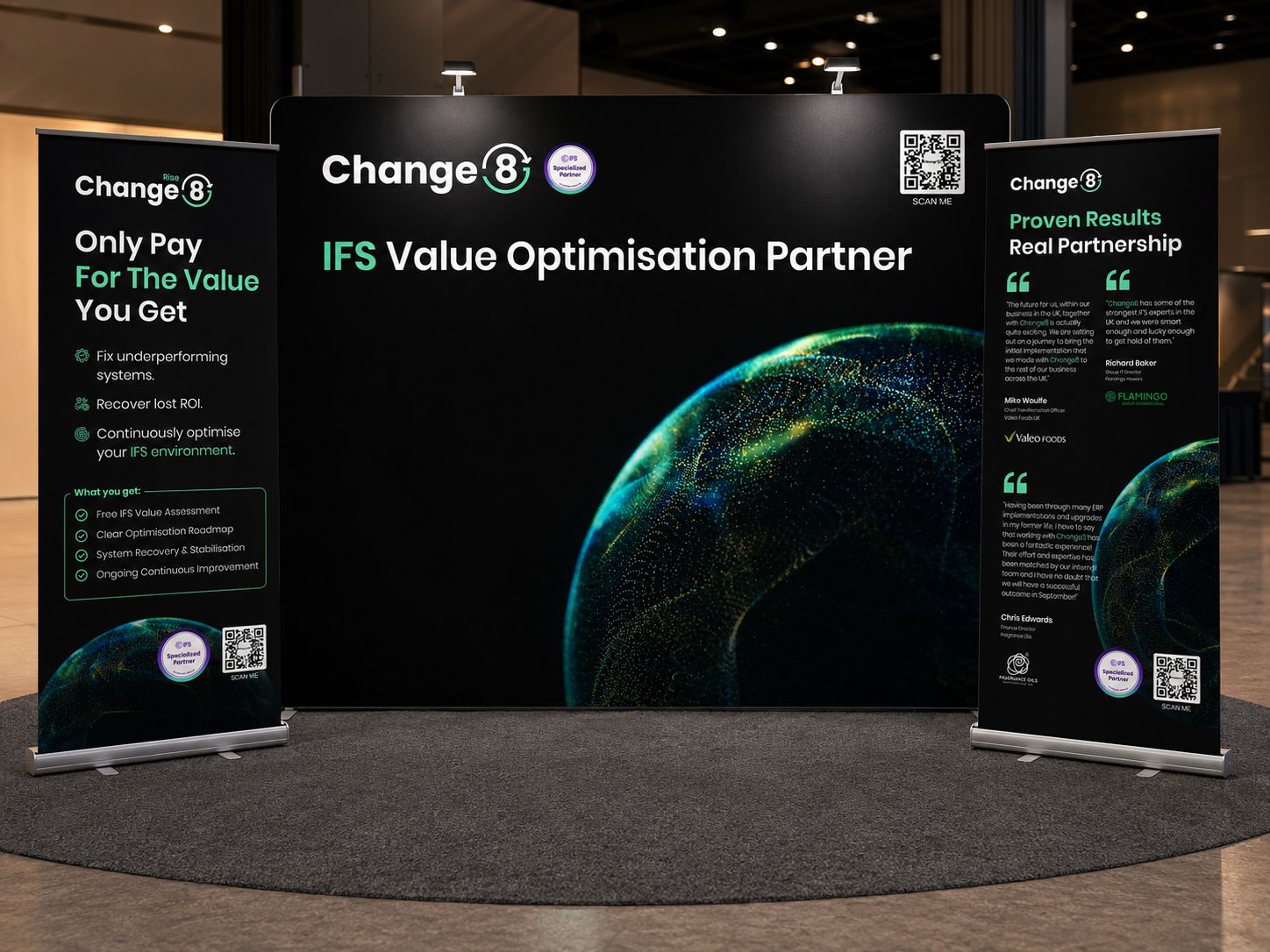
For Change8, the backdrop was built around one IFS-focused proposition rather than a list of everything the company could sell. Supporting pull-up banners carried the detail, while the QR-linked action gave interested visitors a clear next step.
That is the part we can prove from the work. It shows a deliberate hierarchy and a design system built around a specific conversation. We are not claiming a conversion result that cannot be tied back to reliable event data.
Client review
“Alex has been instrumental in helping both Gtech and Change8 with our social media campaigns and marketing material ... along with a drive to ensure our marketing and brand stand out.”
Holly Rascagneres, LinkedIn recommendation, 8 July 2026
Your designer can do this, but ask the right question
A competent designer can build a print file. The question is whether they will design around the installed layout before they start arranging the content.
Ask to see the artwork placed into the booth layout with the fixed elements visible. Then check whether the headline, proof and next step still work from the aisle. If the review only shows a clean flat artboard, you have not yet seen the design under the conditions in which it must perform.
Preflight rejections and late structural changes are what turn a comfortable timeline into a rushed one. With the 4 September deadline approaching, the safest route is to settle the message and layout before the final production file is built.
What the Ascension design offer includes?
Backwall design from £600. The starting price covers the main booth graphic built to the official template you provide. The final price is confirmed after we see the brief and files.
First concept in 2 to 4 working days. The clock starts when we have the current template, usable logo files, approved copy and a confirmed slot. We confirm the delivery date before work begins.
Print-ready artwork. The final file is prepared and checked for the official submission route.
Optional supporting assets. Pull-up banners and screen graphics can be added where required and are quoted separately.
Booked an exhibitor package?
Send Ascension the package name, current artwork template, vector logo files, approved proposition and the destination for any QR code. We will confirm the scope, price and concept date before work starts.
Questions worth asking before you commit to anything

Specialist marketing for ERP consultancies. LinkedIn-led, sales-aligned, and built around how the ecosystem actually works.
.svg)